December 23, 2025

Healthcare marketers have long grappled with a fundamental challenge: digital media performance doesn’t necessarily lead to real-world clinical and business outcomes. Reach, click-through rate, and viewability all have their place, but they can’t tell you if the right patients and providers were reached, if they prescribed and started therapy, and ultimately whether your media investment delivered ROI. As the digital landscape evolves, and consumers and providers expect more and more from healthcare brands, the industry is embracing a critical truth: the most meaningful KPI is offline impact.
From Proxy Metrics to Real-World Performance
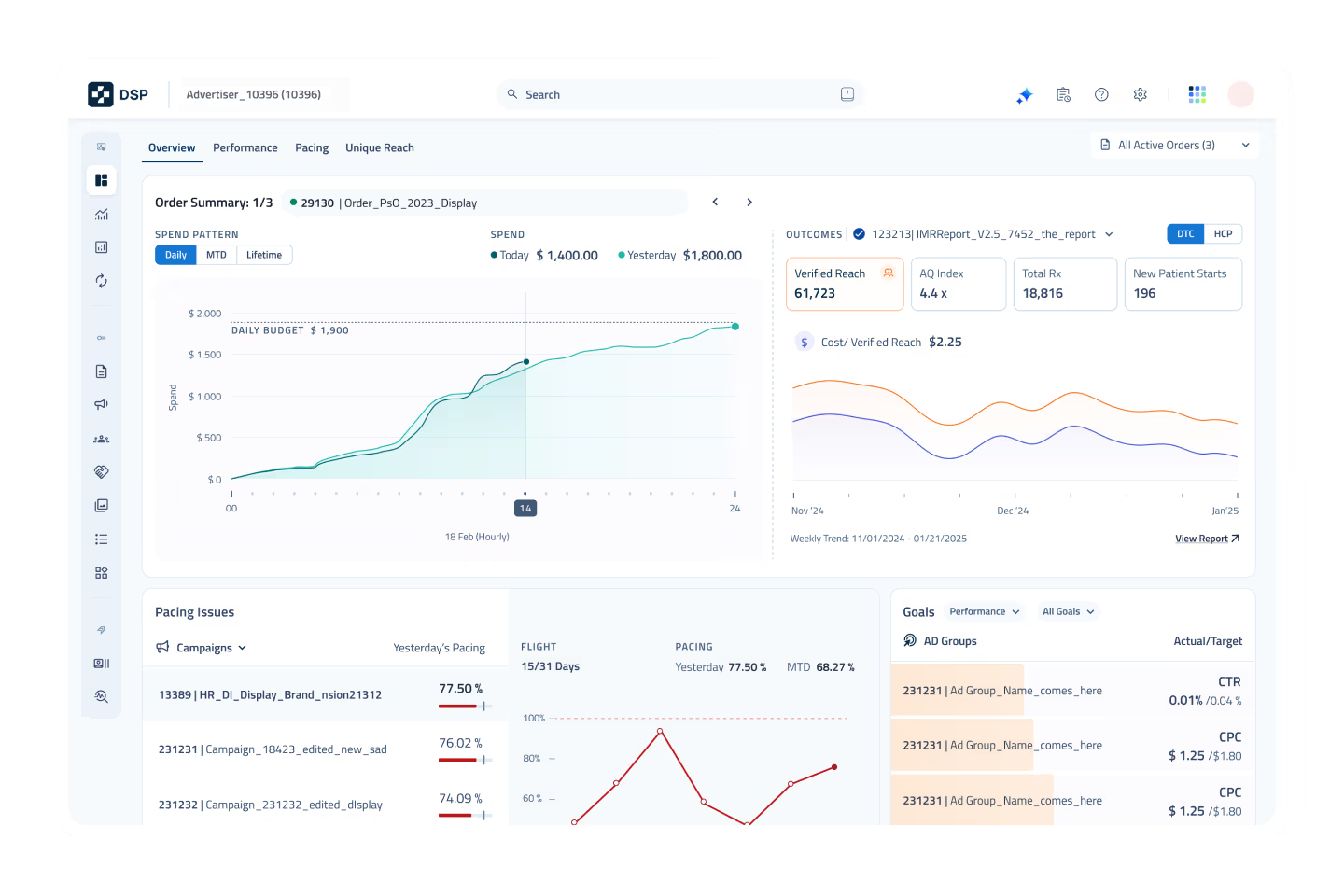
Online-to-offline optimization, powered by AI, bridges the age-old gap between digital media and patient behavior. It connects privacy-compliant healthcare data with programmatic media opportunities, so marketers can optimize toward real-world metrics such as new patient starts (NPS), script lift, audience quality (AQ), and cost per TRx, not just impressions delivered.
This shift transforms how campaigns are planned, activated, and evaluated. Instead of using digital engagement as a proxy for intent, optimizing for offline health metrics allows marketers to reach and optimize toward the audiences most likely to drive prescribing outcomes. In many cases, brands that adopt this optimization see AQ increase by 41% or more, with corresponding gains in NPS rising by more than 3.5X and decreases in cost per TRx of 88%.

Why Daily Refreshed Healthcare Data Matters
The ability to achieve this depends on one pivotal ingredient: fresh, accurate healthcare data. Patient journeys evolve rapidly, with new diagnoses, insurance changes, drug availability, and other factors constantly affecting eligibility and intent. Traditional audience segments built on stale data can’t keep up.
With daily refreshed medical and pharmacy claims signals feeding into AI-powered predictive models, marketers can ensure that their campaigns reflect the real world as it exists today, not weeks or months ago. This enables:
- Dynamic audience refinement, improving AQ throughout the flight.
- Predictive optimization that allocates spend to the audiences and channels most likely to convert.
- Faster learning cycles, shrinking the lag between insight and action.
Effectively, this optimization helps solve pharma advertising’s relevancy problem. Teams are empowered to reach the right patients and providers, and thus align media investment with clinical and commercial outcomes.
The Future Belongs to Media Optimized for Outcomes
Unifying daily refreshed healthcare data, predictive modeling, and outcomes-based optimization to improve real-world performance is the foundation for privacy-first, relevant healthcare marketing. At DeepIntent, we call this Health Intelligence™.
The promise of Health Intelligence is simple: reach the right patients, drive meaningful action, and prove it. As the industry moves toward outcome-based expectations, this specialized AI is no longer a “nice to have.” It is the foundation for relevant healthcare marketing in a privacy-first, data-driven world. Marketers who adopt these strategies are better equipped to justify spend, demonstrate real ROI, and deliver tangible value for both brands and patients.
Learn more about what marketing powered by Health Intelligence can do here.